Showing posts with label News and views. Show all posts

Monday, June 30, 2014

Australians ask: What are we really burning?

Devastation to biodiversity/wildlife during prescribed fires


My friends and colleagues at the Portland Field Naturalists’ Club (Portland, Victoria, Australia) sent me this video made jointly by them and another (Hamilton) Field Naturalists’ Club. Together, they created this hard-hitting, difficult-to-watch video, published June 24, 2014.

Back story: The state government of Victoria has an ongoing commitment to the prescribed burning of 5% of the Crown Land in the State of Victoria. The government does this in order to prevent wild (or intentional/unintentional human-set) fires from endangering homes, businesses, livestock and other establishments/organizations/etc which are considered at risk from fire and hence, more important than the conservation and respect for environmental biodiversity, including wildlife.

Despite lobbying the various levels of government, the two Field Naturalist Clubs believe their well-considered opposition to the controlled burns has been ignored. They are particularly concerned about the excruciating death by burning experienced by wildlife such as koalas, wombats, kangaroos, echidnas, powerful owls, and frankly, anything that moves. Not to mention the flora.

Please watch this video to learn what prescribed burns really do. Note: because it contains graphic images of burned animals, this may not be appropriate for children.

Then?

Please also consider that this is not “just” a far-away-in-another-land issue. Here in Canada we allow prescribed burns. How do you feel about this? 

What can we do?

My colleagues at the Portland Field Naturalist Club suggest we write to the Victorian Environment Minister Ryan Smith: They wrote:

Every year the Victorian Government burns large areas of bush under the banner of protecting human lives and assets, but is this really what is happening? Concerned? Contact the Victorian Environment Minister Ryan Smith, the man responsible for overseeing prescribed burning in Victoria on ryan.smith@parliament.vic.gov.au

Saturday, June 28, 2014

Elizabeth Le Geyt: Bird Lady and centenarian

Former Ottawa Citizen bird columnist publishes book... and turns 100!


Happy Birthday, Elizabeth!

Today, Elizabeth Le Geyt celebrated her 100th birthday and launched her first book, Bird Lady: A lifelong Love Affair with Birds.

Check this link for some stunning colour images of birds featured in Bird Lady, taken by such renowned Ottawa-area birders as Tony Beck and Bruce di Labio.

Readers of her popular bird column in the Ottawa Citizen can now read Elizabeth’s stories about how her love of birds was transformed into a highly respected column... and book.

I can’t wait to read a copy!


Thursday, March 20, 2014

Plant intelligence: how do we measure it?

Canadian Museum of Nature explores concept of plant intelligence


The latest session of the Museum’s “Nature Talks” series of lectures was held Tuesday March 18. Topic? Globe and Mail science reporter Ivan Semeniuk interviewed Paul Sokoloff, a botany research assistant at the Museum, on the subject of plant intelligence. (Watch a video of this next week at nature.ca.)

Do plants “think”? Not as human beings do. However, Sokoloff said they possess something analogous.

“Electrical pathways are analogous to animals’ central nervous systems,” he said, “Of course, plants have no brain. But even though plants are stationary, they do a lot of what we often consider to be ‘intelligence’' They move in response to light. Roots detect gravity and send their shoots up through the soil to the sky.”

Among many other things, noted Sokoloff, plants detect humidity, minute changes in carbon dioxide, and soil PH. Of special interest to me was his claim that plants can resist being consumed by grazing animals because they can adapt chemically, to become less palatable. (Does this drive hybridization, I wonder, as we develop more tasty and nutritious grazing plants for beef and dairy cattle, for instance?)

During the conversation with Semeniuk, Sokoloff discussed plant memory and learning. He cited a researcher’s lab tests with Mimosa pudica (sensitive plant) where plants were repeatedly dropped. At first, as always happens when this species’ leaves are touched, they folded upon impact with the ground. However, after a while, they stopped doing so. The question is: Did these Mimosa plants learn to ignore stimuli which did not hurt them?

In a follow-up interview on Thursday March 20, I asked Sokoloff what types of chemicals plants use to successfully compete for space, light, and hence, survival.

“Black walnut trees emit a chemical called juglone which is released by their roots.” Insodoing, other plants cannot grow in soil adjacent to this species. In fact, Sokoloff told me, “Probably nothing much grows until the chemical is metabolized by the soil.” 

We don't normally think of plants polluting the soil... However, is this intelligence?  Thoughts? For more information, check Oxford Journals: Annals of Botany blog.


Tuesday, February 4, 2014

Used Book Drop-off: March 29 10:00-15:00h

Recycle your old books

Friends of the Farm’s annual Used Book Drop-Off will take place on Saturday March 29th from 10:00 a.m. to 3:00 p.m.
They do not accept magazines, textbooks or encyclopaedias.
The book drop-off is located at Building 72 east of the Prince of Wales roundabout. For more information contact info@friendsofthefarm.ca or 613-230-3276. 

Sunday, February 2, 2014

Black River/Green Lake: Impassable!

Impassable roads; significant flooding


The chemin Rivière Noire/Black River Road located north of Highway 148, east of Waltham is flooded at kilometre 17.5.

The bridge opposite the Black River Inn (at kilometre 18.5) was closed by the Municipality of Waltham on January 31, with concerns the ice and river levels may push it off its piers. So far as I know, the bridge platform remains okay, but the bridge itself is deemed unsafe.

Also, riverwater flooded the road at the bridge in front of the Inn...  so the Black River Road remains impassable with water and ice to a depth of 5 or so inches (again, as of 31 January).

The Green Lake Road/chemin Lac Vert is also blocked. Moreover — and for the first time in anyone’s memory — Lac Vert’s water level rose 13 feet. However, as of today, the lake’s floodwaters have gone down 5 inches, to 9.5 feet above normal. Eric and I wonder how our beach barbecue has survived -- built by Bob and Dorothy Fletcher, it has great sentimental value to our family.

March 2013 image of ice jams on Black River. This year,
water floods the road and ice makes it totally impassable
at km 17.5.  Photo: Eric Fletcher 2013
Last year in March 2013, Eric and I took photographs of the ice jam on the river. At that time, as this photograph depicts, the Green Lake Road was not affected. (This photograph was taken beyond the Black River Road, which becomes the Green Lake Road at the bridge beside the Inn).

I will post pictures of this year’s flood when/if I receive permission to do so.

Tuesday, January 28, 2014

Pete Seeger dead at 94, January 27

One of my environmental advocacy “heroes of all time” passed away last night. Pete Seeger’s legacy is tremendous: a folk singer who used his lyrics and music to advocate for positive change in America and throughout the world. In the Sixties, he spearheaded the movement to raise consciousness about water quality, when he wrote and sang “Sailing up my Dirty Stream” — a song about the Hudson River which had become a polluted, “open sewer.” Thanks to Seeger and his Hudson River Sloop Clearwater, the river was cleaned up. Thinking of his impact on Canadians — and the Ottawa River which marks the boundary between Quebec and Ontario for hundreds of kilometres — his advocacy is represented by the Ottawa Riverkeeper — an initiative that is part of the world-wide Waterkeeper Alliance started by Robert F. Kennedy Jr.

Seeger’s advocacy raised our awareness about “not only” water, but also civil rights, issues related to nuclear energy, and more. To me, advocacy such as Seeger’s proves that our words, our deeds, our art represent important instruments which can champion change for a better world. His 94 years offer us an inspirational legacy. What will our legacies offer our community and our world?

Monday, January 27, 2014

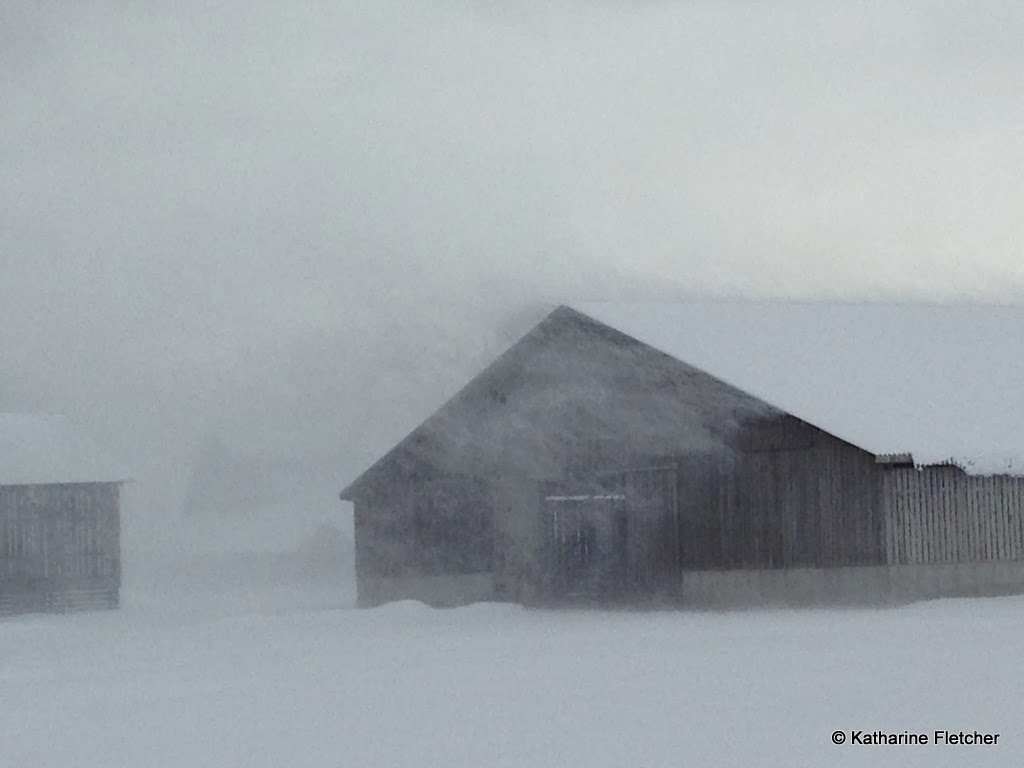
Whiteout!

My drive into Ottawa yesterday was fraught with dangerous winter conditions... right from the start.

Here, on the Steele Line, I confronted my first of many whiteouts. Treacherous howling winds had their way with snow, whirling it about, obscuring the road.

Once on the highway, gusts hurled snow into the roadway, creating drifts. Lots of vehicles dotted about the road; people on cell phones, other Good Samaritans beside them, helping out.

Minus 37C temperatures made filling the vehicle with gas challenging... and, after paying inside the gas bar, I could only just see my car as another whiteout had descended. I felt as though I was in the midst of a snow maelstrom... I guess I was.

I waited out the whiteout... and slowly proceeded.

As a hardy Canadian, this is winter...

Wednesday, January 5, 2011

Back Home in Pontiac

It’s good to be home. We arrived at Spiritwood on Friday, December 17 after driving across Canada – an amazing, fantastic trip where we eluded all of winter’s wrath and simply enjoyed the magnificence of our country while adventuring east.

Several readers and friends expressed concerns regarding whether Eric and I would return to the Pontiac. Many thought we perhaps wouldn’t come back, posing questions such as: Was our journey driven by a desire to discover a new place to live? Had we found a country which irresistibly beckoned us to emigrate?


Thursday, August 13, 2009

Sunny and … hot?

Summer has finally arrived.

I know that because for the second time this summer, we turned on the geothermal heat pump’s air conditioning feature. As the outside temperature reached 28+, the house became a cool 20 Celsius.

The forecast calls for sunshine and hot weather until Tuesday, August 18. It’s about time, say most everyone you’d talk to, especially farmers who are mourning the loss of their cornfields.

In some poorly drained fields, corn has been drowned. In others, the usual summertime heat units have stunted the size of ears of corn, or otherwise arrested its development.

Tuesday, July 7, 2009

City of Ottawa By-laws out of step

Regarding Hank and Vera Jones' Allbirch Pollinator Garden and the City of Ottawa's demand that they mow down their "weedy" garden, I'm posting my letter to the editor at the Ottawa Citizen here. Go to the Citizen's story (July 7/09) about the Jones' project and their hopes to have the City retract the Bylaw infraction charge.

Hank Jones in Allbirch Pollinator Garden, Constance Bay Village, City of Ottawa. Image by Eric Fletcher
I believe that the City of Ottawa's By-law 2005-208 is out of step with current ecological, habitat-friendly practices and that it ought to be rewritten.

It is exquisitely ironic that in 2009, the City of Ottawa is charging Hank (Henry) and Vera Jones with a By-law infraction because of weeds and unkempt gardens. This is particularly the case in this day and age when we’re all supposedly looking for eco-friendly solutions promoting biodiversity. And at the very time when Ontario has joined Quebec in banning cosmetic use of chemicals!

On the one hand, we the public are encouraged not to use herbicides and pesticides which enter the food chain by contaminating soil, groundwater, wetlands, and air. Yet, on the other hand, people such as the Jones' are penalized for naturalizing their gardens.

Moreover, we are encouraged by scientific research and such worthy organizations as the Canadian Wildlife Federation and Fletcher Wildlife Garden to “go native” by planting native species in our gardens. This is crucial because some native insects, butterflies, moths as well as other pollinators and wildlife depend upon native species when it comes to their food. Consider the Monarch butterfly and its dependency upon milkweed.

Many of us are aware of the international decline in pollinator species. This extremely serious issue which affects world-wide food security has been widely published in all media for a number of years. How do we, as individuals, assist pollinators to thrive? By encouraging native plants, by creating habitat biodiversity – just like the Jones’.

Spiritwood is a biodivese, wildlife-friendly sanctuary. Eric and I don't use chemicals here in our gardens in the hopes that all wildlife can find a haven where they won't be poisoned.

I believe the Jones’ efforts to create a naturalized landscape and to attract pollinators and other wildlife through their garden project ought to be commended and encouraged.

It is my understanding, after taking the time to visit their garden last Saturday and to speak with them, that theirs is a most worthwhile, long-term project. In fact, they intend their Allbirch Pollinator Garden to become a demonstration garden for schoolchildren, garden groups, and indeed, any interested persons.

Therefore, I encourage the City of Ottawa not only to drop their By-law infringement charge against the Jones, but also to consider immediately rewriting such by-laws so that naturalized landscapes in people’s lawns and gardens are encouraged, not threatened by the application of inappropriate by-laws.